Showing posts with label scuba diving. Show all posts

Monday, June 27, 2011

Underwater navigation: A guide to find your way without a guide

 Finding your way
When I was just certified as an open water diver I was always amazed at how well my experienced buddies, most of them having 200 or more dives, knew where to go, to find some special object. Where I was just watching the scenery, my buddies navigated on natural features and compass and showed me the best places of the dive spot. Even more impressive, they found the way back and we surfaced almost at the same spot as where we started. Of course, in the open water course we learned some basic navigation skills (swim straight at one course and straight back), but that is not in the same league as the routes we swam underwater.

To get those navigation skills as these buddies of mine have there are a couple of things I did three things:
  • Learning
  • Practising
  • Doing it

Learning to navigate
When I started to get familiar with some of the dive spots, it became easier for me to see where they were going and I knew the way back, but still I didn't know exactly where I was, which was becoming a bit frustrating I must admit.
Doing the advanced open water course with one navigation dive improved the sense of positioning. Learning to measure distances by counting my kicks or by measuring time helped a lot. Getting more comfortable using the compass helped a lot too. And finally, learning to watch for "underwater landmarks" was like seeing the underwater world with a set of new glasses.
The exercise that stuck with me the most (and built my confidence on my navigating skills) during the underwater navigator specialty course was that my instructor sent me in all different kinds of directions for all different kinds of distance trying to get me disorientated. We did this in very dark water where I couldn't see the bottom nor see the surface. After that she asked me to navigate to the point where we started the dive. When we surfaced just a few meters away form where we started, I knew I could do it...

Practising and doing it
While I got more familiar with the dive spots we were diving at, first I tried to watch my compass and my depth gauge to find out what our route was. That worked for a bit, but not to my satisfaction... When I was not "in charge" of the navigating, I soon was looking at the scenery and not watching where we were going. So at a point I asked my buddies if I could do the navigating and that they should correct me if we were going the wrong way, or swam past our entry point. I think that this was the best way for me to learn, together with the navigation specialty. I found out that if you get to know the dive spot very well, you hardly need the compass anymore, you can just navigate on the landmarks. In the beginning I was corrected, mostly for swimming too far back, but after a while I found my way back completely. And I must say, knowing where I am and knowing I can find my way back has made me a lot more comfortable underwater.

How to be comfortable navigating underwater
So far I have been talking about my own experiences in divespots I was already familiar with. But how to get comfortable in diving and finding your way at a new spot? In my humble opinion it comes down to two points, skills and preparation. We already discussed the skill part, learn, practice and do it so I'll skip that here.


To prepare for a new divespot you could do the following:
  1. Check for underwater maps and other info.
  2. Set a route with your buddy
  3. Write down the course, depth length
  4. Divide the tasks
Before I go to a new dive spot I start with a google search to see if there are any underwater maps of the spot we are going to. For (almost) all divespots in The Netherlands I go to a divemap website and check all the maps available. Most of the times I print the most recent map, at least when there is enough detailed. I take this map with me to the dive spot en discuss a route with my buddy. Which parts of the site do we want to see and in what order will we go to them? If your not sure you can remember all the courses and depths and lengths, you can always write it down on your dive slate and check it if you have done that part of the route. Last we agree on who checks the course and who checks the depth and distance of our route.
I hope that this is helpfull for helping you, and otherwise, just follow the traffic signs....


Dive safe and have fun,


Thursday, February 3, 2011

Starting the rescue diver course

First dive of 2011
 
It's been a while since I posted an entry here and I'm sorry for that. But for a "wet" diver, the winter period isn't the time to go diving frequently. With water temperatures of 0-5 degrees Celcius I, at least, don't dive very relaxed for very long.. So here is a small update.
However, last Saturday I made my first dive of the year with my open water and advanced open water instructor, Willem. It was freezing outside and the water was only 3 degrees, but we stayed under for half an hour. After a hot cup of coffee I got back the warmth in my fingers and toes and we started talking about our plans in diving.

Rescue Diver
Willem told me that he loved the intro to cave diving course he had done in Spain and is planning to go further in learning to cave dive. I, on the other hand was talking about my diving goals for this year. My first dives abroad are booked and also the tickets for a week of diving in the Red Sea are booked (I hope they get Mubarak out of office soon and it will get peaceful again).
And with Willem and I already agreed that I'll be doing the Rescue Diver course in spring with him. Willem already had the course pak already for me. So I've already started studying and watching the DVD. And, of course, I'll be reviewing the EFR manual again to refresh my memory....

As I go along the course I will keep you informed on my progress and my vies on the stuff and skills I'll be learning......

And of course, after my dives in Portugal I'll tell you about it too.

Dive safe and have fun,

Saturday, January 1, 2011

New year, new goals

First of all, I want to wish everyone a happy new year. And of course happy diving....

The holiday season is allways a time to look back at the past year and look forward to the upcoming year. The new year is also the time when we make list of good intentions. We want to loose weight, eat healthier, stop smoking and the list goes on. I'm not any different. From here on I want loose at least 10 kilos and pick up running again; a better physical shape will help me when diving as well.
But that's not all. I've been pondering about what I want to get out of diving. And what I want to do with it. And with that 2011 will be a year of change.

Goals
First of all I want expand my knowledge and skills and will start the Rescue Diver course. With that I think I will become a better buddy. Also I want to increase my experience. So I'd like to make at least as much dives as I've made in the last two years. So in my logbook should be at least 90 at the end of the year. Of course I'll aim for 100.
I also want to try a bit more demanding dive sites. I've made some dives in the Oosterschelde at low current sites but I'd like to try some other sites which are more demanding too.
Furthermore I'd like to go diving outside The Netherlands. I've made the first arrangements to go diving during our vacation in Portugal and am aim to go on a dive trip to The Red Sea.

And last, but not least, I'd like to share my knowledge and experiences with others. I'm not an experienced diver (yet), but I've already learned quite a lot by diving with more experienced divers. And I noticed that when diving with less experienced divers I loved to give them some pointers and also felt a responsibility for their safety.
So instead of aiming for the master scuba diver rating I now want to "go pro". So I'd like to become a divemaster. Whether that 'll be this year already or next year is to be seen, but I will go pro!!


List
So to sum up my goals for 2011:
  • Pass the rescue diver course
  • Aim for 100 total dives
  • Dive in more demanding spots
  • Dive in Portugal and Egypt
  • Become a divemaster
Dive safe and have fun

Wednesday, December 22, 2010

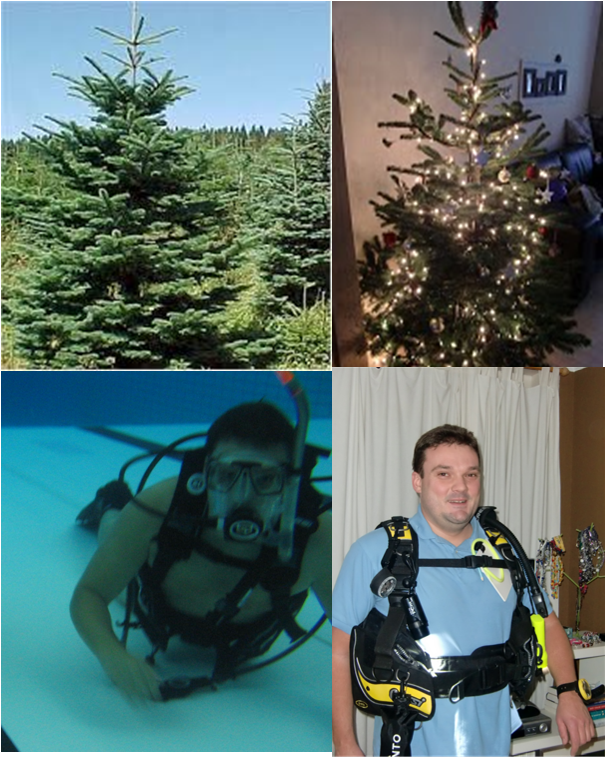
Scuba Gear: Becoming a Christmas Tree

With Christmas just a few days away, all of the city of Rotterdam is decorated with light, bells and all sorts of other Christmas decorations. More special even, the city is covered with a decent amount of snow....And of course, our house is pretty much the same. Without the snow of course. And as I am a member of the declining race of people who buys a real tree, I was dragging a nice and green, great smelling, tree into my house.

While my girlfriend was decorating the tree, I was catching up on some dive reading and thinking about all the scuba gear I still wanted to buy. And when I looked at the tree again it hit me.......

All suited up, I am the Christmas tree.

I will try to explain what I mean.

When I took my first scuba lessons, I started with the basic scuba gear.
So starting with a mask, snorkel, fins, wetsuit, BCD, regulators, a weightbelt and a console, I hit the pool and later Lake Oostvoorne. Like most novice divers I had my hands full with all of that gear. It was hard to check the compass, stay trimmed at the same time and look at my instructors, divemasters and fellow students, but I managed, no more, no less.

After the open water course I started diving with the dive team of the divecenter and after I made sure I loved scuba diving, I started to acquire my own gear. Of course I started buying the list above and (tried to) get familiar with it.
Wanting to improve my diving skills en experience all sorts of different types of dives, I enlisted in more diving courses. And those courses needed me to by more gear.
Starting with the advanced open water course, I needed two (regular and backup) lights. Then I needed a dive slate, to determine a course during the navigation specialty course. And last, for the deep diver specialty I had to get a safety sausage (SMB) to use during safety stops.

Now back to the tree. When it was still in the forest, all it's branches were free. At most there was a bird's nest on one of them.... But now, all decorated, every branch had something on it; whether it's a light, a ball or some artifical snow.
And my BCD is the exactly the same. At first there were just the console and the octopus, but now all the rings are used to hang all my stuff....


See what I mean?


The worst thing is, I still need (want) more gear... I still have quite a long wishlist that I sent to Santa....
I always thought of myself as a pretty down-to-earth guy, but looking at all the gear I have acquired in two years time, I have to ask myself:

Am I a scuba gear junky?

Something to ponder about during the Holidays.

Have a nice Christmas and a happy new year....

Menno

Monday, October 18, 2010

Deep diver specialty

Lot's of beautiful wrecks and reefs are located deeper than the 18 meters you're allowed to dive when having an open water diver certification or even deeper than the 30 meters with the advanced open water diver certification (padi). So if you ever want to dive those wrecks or reefs, extra training is required. The last two weeks I've taken the deep diver specialty course so I can dive those spots in a safe and responsible way.  I want to share with you what I've learned during this course.

When doing a specialty course, you learn in two ways, from the textbook and from the dives. And I must say, I've learned the most from the last dive. Because for that dive, I had to make the dive plan, do the briefing and go through the safety procedures.

From the textbook

Before the dive
Before you even put on your gear set a goal that is realistic for you and your buddy. Take into account the expected circumstances underwater and both your experiences with them. Making a 35 meter dive in tropical water just isn't the same as making a dive to that depth in cold, dark water.

A goal and a plan
First of all you need a goal for your dive and a decently set up plan. Don't just go in and see what happens. It will put you and your buddy at great risk. Make a decent and conservative plan to visit that great wreck and stick to it. Because of the short bottom times at depth (no deco time), make sure you can descend and descend very close to the goal of your dive.

Buddy check

Well, of course, you should check your gear before each dive, but before a deep dive you should do this even more carefully. Gear failure at depth can cause a lot more problems than at 10 meters, and it's a long way to the surface. So, do a very thorough buddy check...

While diving
Check your air regularly. At 30 meters your air consumption is twice as much as at 10 meters. So check it regularly and that of your buddy as well. And for that matter, maintain contact with your buddy very often, so you'll notice the signs of nitrogen narcosis. Turn back well before you're low on air. You still need to do a safety stop, so make sure you both have enough air for that.

Ascending
When you're at the spot where you want to ascend, release your safety sausage. The safety sausage makes people on the surface aware that there are divers below. It will reduce the chance of being run over by a boat. Then ascend slowly and maintain (almost) neutral buoyancy. At 5 meters, do at least 3 minute safety stop. And then continue to ascend.

The dives
From the four dives we made in the course doing different kinds of exercises like answering diving theory questions and doing math. Also we looked at colour changes underwater and the effect of pressure on object filled with air. And for the first time, I had to use a safety sausage.
But the most educating dive was the final one. I had to prepare the dive, determining bottom time, descending and ascending procedures, agree on hand and light signals. And of course, navigate the whole dive.

Also I had to prepare emergency procedures and had to do the briefing.


The dive itself was cold (5 degrees at the bottom) and dark. But with our lamps, visibility was very good. And everything went as planned.
This course has made me look at a dive in a more serious way and taught me a lot, especially when I have to lead a dive.


    Friday, October 15, 2010

    European Shark Week

    This week it´s European shark week. Project Aware is working together to with the shark alliance to ask the European parlement to sharpen European shark finning ban.

    And because shark fins should be on sharks and not in some bowl of soup, I support the shark week with the post in my blog.

    You can find more on the European Shark week on Project Aware.

    Esspecially for Shark week, I looked on the net for some shark cartoons to make you think about us people..


    More shark cartoons on http://www.shaaark.com

    Friday, October 1, 2010

    Physics in diving (2): Underwater pressure and gas compression

    We can all feel it in our ears when we descend for a dive, or when we ascend at the end of a dive. The pressure changes with depth.


    Water pressure
    At sea level, the pressure is 1 atmosphere or 1 bar. This pressure is caused by the weight of all these kilometers of air in the atmosphere above us.
    In water it works the same. The weight of the water above us determines the pressure working on us. As a rule of thumb, every 10 meters we descend, the pressure we endure increases with 1 bar.
    It is easy to calculate the pressure at any depth. Just divide the depth you are at by 10 and don't forget to add 1 for the pressure the atmosphere is already giving you.

    So at 10 meters the pressure is 10/10 + 1 = 2 bar. In the table there is more.


    Depth
    Pressure
    Surface
    1 bar
    10 meters
    2 bar
    20 meters
    3 bar
    30 meters
    4 bar
    40 meters
    5 bar

    So why is it important to know the pressure underwater? For one, when diving with enriched air, the pressure is needed to calculate the partial pressure.
    An understanding of pressure , together with gas compression, is also needed to better understand the changes in buoyancy when changing diving depth.

    Gas compression

    Gas compression is very convenient in diving. It makes that you can stay underwater as long as you do. By compressing air into your tank you can take air with you to stay underwater for a long time. How does that work?

    Boyle's law
    Boyle's law states that at any given temperature the product of the pressure and the volume of a certain amount of gas, is constant:

    P1*V1 = P2*V2 = constant 

    So let´s say your underwater at 10 meters and the air in your BCD is has a volume of say 9 liters. When you descend to 20 meters, the water pressure will increase from 2 bar to three. The air pressure in your BCD will take on the same pressure. This pressure will make the volume of the air in your BCD change from 9 liters to 6 liters. 
    The other way around, when you go to the surface the water pressure will decrease from 2 to 1 bar and the volume in you BCD will increase to 18 liters.

    Boyle´s law can be corrected for temperature influences. This results in the combined gas law:

    P1*V1/T1 = P2*V2/T2 = constant

    Because when diving, temperature differences aren't that big (unless you pass through a thermocline), I will explain the temperature influence with an example of filling your tank.
    You might have noticed that after you've fill your tank at the dive center, your tank feels a bit hot. Let's say that you filled your tank to 200 bar. 
    Then later on when you have set up your gear to go diving and check your air supply, you might notice that your tank has cooled and when you check your air supply you will notice that you have less than 200 bar in your tank.
    That is the temperature effect working. The volume of your tank is still the same, the temperature has dropped a bit, so only the pressure can decrease to make the formula work.

    Pressure, compression and buoyancy
    So when you change depth, the water pressure changes and the volume of air in your BCD changes with it. These changes have a direct influence on your buoyancy. Your buoyancy is dependent on your weight and volume. As your weight doesn't change when you change depth, only the air volume in your suit and BCD has an influence on your buoyancy.
    When you go deeper the volume in your CD will decrease, as will your buoyancy. That is why you will have to add air to your BCD to compensate for the volume lost by the pressure. Also, when you go up, you'll have to release some air, otherwise your buoyancy will be too positive and you will shoot to the surface, with all risks that come with that....


    Relates subjects:
    Physics in diving (1): Buoyancy

    Wednesday, September 22, 2010

    Physics in diving (1): Buoyancy

    Why does a piece of wood float and does a rock sink? Why does a steel rod sink but will a steel hull boat float? Why do I go down when I deflate my BCD and do I go up when I inflate it?


    It's all about buoyancy.........

    Archimedes

    But what is buoyancy exactly? Legend says that when Archimedes took a bath he discovered the buoyancy principle. He then jumped out of the bathtub and ran into the street shouting "Eureka!!!". Afterwards it was stated as: "Any object, fully or partially immersed in a fluid, is buoyed up by a force equal to the weight of the fluid displaced by the object".

    That, of course, is a very nice statement, but how does it work?


    When a stone is submerged in a fluid, the buoyacy force (Fb) on the object can be calculated by multiplying the volume of the object by the density of the fluid and the gravitational force is the weight of the object:

    Fb = Vo*ρf and Fg = Mo

    But you know the volume and the mass of the stone, so you can also calculate the density of the stone by dividing the mass of the stone by it's volume. When comparing the density of the object and that of the fluid, there are three different states of buoyancy:

    1. Positive buoyancy; The density of the fluid is higher than that of the object. This will result in the object ascending and finally surfacing.
    2. Negative buoyancy; The density of the object is higher than that of the fluid. This will result in the object sinking to the bottom.
    3. Neutral buoyancy; Here the density of the object and fluid are equal. The object will hover. This is the buoyancy state of a diver tries to maintain.
    Diving and buoyancy
    So there are three things influencing the buoyancy of an object, or a diver. These are the density of the water you dive in and your weight and volume, including your dive gear. 


    Salt water has a higher density than sweet water, so a diver has a higher buoyancy in salt water than in sweet water. So in general, in salt water you need to add more weight than in sweet water.


    If you have a positive buoyancy you can ad some weight to put on some extra pieces to your belt or in your BCD. If you alreaydy have a negative buoyancy you can increase your volume by wearing a thicker suit. Never just inflate your BCD to add volume, you'll need that when you underwater!


    You might have noticed that when you get deeper underwater, your buancy tends to become negative; you feel like you are dragged down. This will be discussed in my next entry on pressure and (air) compression


    Related subjects:
    Physics in diving (2): Underwater pressure and gas compression


    Wednesday, September 1, 2010

    Started diving... And blogging

    In spring 2009 I got the opportunity to do a Padi Open Water course with my company. And while I was in the water for most of my life (competitive swimming, water polo), this sport or hobby looked like it was made for me.


    So after four nights of theory lessons with repeatedly setting up the diving gear and four practice rounds in the pool, at june 6th we were finally ready to go into open water (Lake Oostvoorne).


    I was a little bit anxious about that first open water dive, but after a minute or two, I was already getting really comforable under water. 
    Although we didn't get to see too much of wildlife, it still made me want to see more.
    Me and 11 of my collegues made it through the exercises and as a bonus, we all became a member of the dive team until the end of the year.

    And because of the dives I made with the dive team in mostly Lake Grevelingen, I am now so hooked that I am aiming for the Master Scuba Diver Rating.

    Follow me in my quest to get that rating and in all my other diving experiences.

    Want to read this page in another laguage? Check below...